What umlaut domains are
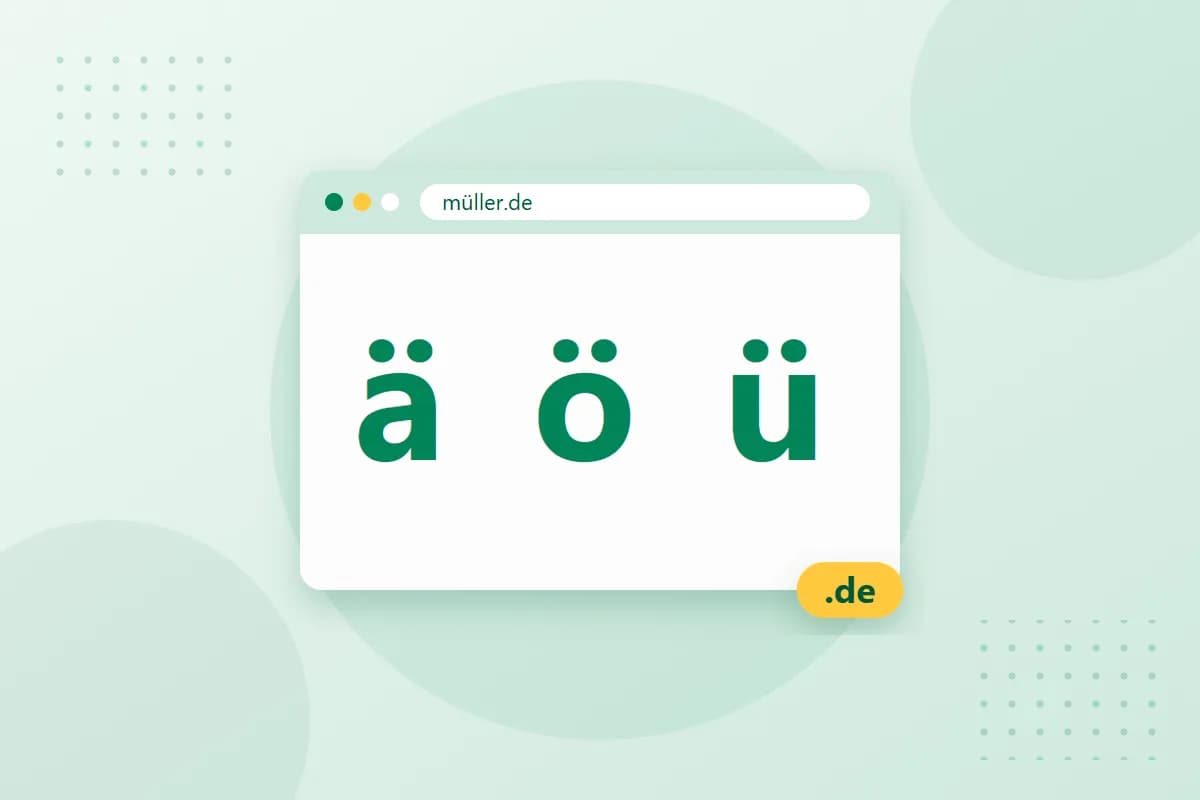
Umlaut domains belong to the internationalised domain names, or IDNs for short. They contain characters outside the basic Latin alphabet. For .de domains, numerous special characters are allowed in addition to ä, ö and ü, and since 2010 the ß as well. This means company, place and family names can be written as they really are: müller.de, bäckerei-schäfer.de or straße.de.
How they work technically
At its core, the Domain Name System only understands letters without special characters, digits and hyphens. Your browser therefore automatically converts an umlaut domain into what is known as Punycode. Internally, müller.de becomes xn--mller-kva.de. Visitors never see this: they type müller.de and land on your website.
The advantages
- Correct spelling: your name appears exactly as it does on your shop sign.
- Better availability: many umlaut variants are still free, while the spelling with ue was taken long ago.
- Protection against confusion: owning both variants prevents third parties from using the other spelling.
The pitfalls
Older programs and some forms cannot handle umlauts. Caution is needed above all with email addresses: an address like info@müller.de is not yet processed reliably by every mail server. Keyboards abroad also lack umlauts, which causes problems for international customers.
Our recommendation: secure both variants
The best solution is usually a combination. Register the umlaut domain and the spelling without umlauts, i.e. müller.de and mueller.de. Use the variant without umlauts for email addresses and redirect the umlaut domain to your main website. That way you benefit from the natural spelling without taking any technical risks.
Conclusion
Umlaut domains are a charming and often still available addition to your .de address. Check right away in our domain search whether your domain name is available with and without umlauts.